
Throughout my childhood, the only profession I knew—and perceived—as having requirements about how you should sound versus how you actually sound was journalism. In most French-speaking African countries, national news anchors always sounded “French.” Not because of their reporting style or content, but because of the sound of their voice—their accent. That was my earliest experience of professional speech shaped by external expectations.
Over time, I’ve come to realize that journalism is not the only industry where the “sound” of one’s voice is consciously shaped. Tourism, particularly in Sub-Saharan Africa, also carries this dynamic.
I noticed this during my travels in East and Southern Africa regions. But the most striking case was in Zimbabwe—especially (though not exclusively) in the city of Victoria Falls. In fine-dining restaurants or during guided tourist activities, I was mesmerized by the effort employees put into sounding “British.” Even more fascinating was the generational balance in this mimicry. Older and younger workers alike seemed to adopt it—despite their very different historical experiences. Zimbabwe, after all, gained independence in 1980, making it the last country in Southern Africa to break free from colonial rule. Only 45 years separate today’s guides from the brutal legacy of Cecil Rhodes and the Rhodesian political system.
This raises a pressing question: Why do employees in the hospitality and leisure sectors modify their accents and sometimes desacralize their cultural heritage?
I am writing from a mix of personal reflection and research observations. Some of the insights I share also come from conversations with fellow tourists (yes, often after their second glass of wine). So I invite you to read the following arguments with curiosity and openness.
1. Speech accommodation and colonial legacies
From a psychological and sociolinguistic perspective, humans naturally adapt their speech patterns to their environment—a process called speech accommodation or linguistic convergence. In tourism, where most customers come from Western countries, adopting a Western accent becomes a way to align with clients’ expectations and to appear more “appropriate.”
But there is also a deeper, historical layer. Under colonial rule, education was often tied to assimilation. Access to prestigious schools frequently required adopting the language, manners, and values of the colonizers. Beyond assimilation, true “acceptance” demanded even more: speaking, dressing, and behaving like the colonial elite to prove belonging. Accent, then, became a marker of distinction—a subtle but powerful way to separate oneself from the masses and climb closer to the status of the dominant group.
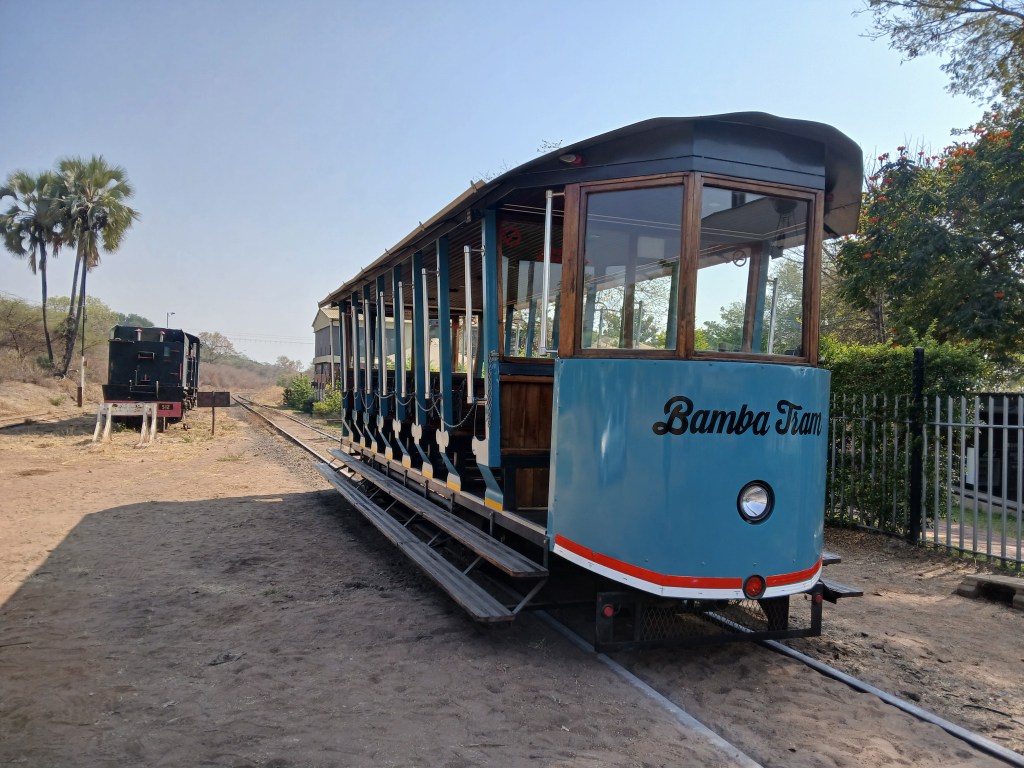
I was reminded of this while on the Bamba Train in Victoria Falls. Our young guide did not just sound British—he carried himself like Winston Churchill, complete with rhetoric and posture. His narrative about the Victoria Falls Bridge praised British engineering but omitted the most important fact: the bridge was built with African labor. Local men endured unimaginable hardship, pain, and loss to raise that structure, yet their story was erased in his retelling.
This selective memory is not trivial. Tour guides, standing at such iconic historical sites, have the power to tell critically balanced stories. Yet too often, their narratives echo colonial legacies rather than amplifying African perspectives.
2. Financial incentive
The second argument is more straightforward: money.
Accents, like appearances, can be monetized. Many in the hospitality sector believe that adopting a Western accent increases their chances of receiving tips or being perceived as more professional.

Let me take you to Uganda for an illustration. In restaurants, when I’ve dined with Caucasian friends, the bill is almost always handed directly to them. The assumption? “White customers tip better.”
On one occasion, I placed my order, but the waiter’s body language—his eyes, his posture, his entire attention—was fixed on my Caucasian friend. I felt invisible. When I confronted him, his only defense was a quick apology. Experiences like this fill my memory.
To my dear Caucasian and Western friends: I can’t keep fighting this battle. The next time the bill comes to you first, consider it part of your informal colonial reparations. I’m done arguing.
3. Institutional pressure
A third, more unsettling possibility: sometimes the performance is not voluntary. What if businesses themselves encourage—or even require—employees to sound Western?
I have not formally investigated this in Sub-Saharan Africa, but I’ve seen parallels elsewhere. My sister once worked in hospitality in France, and her supervisor bluntly told her: “Your accent does not suit the brand.” She left that job, thankfully. But this raises questions about how much of the “performance” in African tourism is shaped by unspoken employer expectations.
Final reflections
Tourism, in many ways, has become one of the most visible stages where colonial legacies continue to play out. Accents are not neutral. They carry history, power, and economic implications. In Zimbabwe, Uganda, and beyond, they reflect a complex negotiation between memory and survival, dignity and financial necessity.
The sequela of colonialism is not just written in history books—it lives on in people’s voices, in the way stories are told, and in how customers are served.
The challenge, then, is not only to recognize these dynamics but to imagine alternatives. Can tourism embrace authenticity without punishing it? Can guides tell stories that honor both history and the people who built it? Can workers earn financial stability without needing to mask their cultural identity behind a foreign accent?
These are not easy questions. But asking them is the first step toward transforming tourism into a space of healing, rather than performance.


 Cameroon Passport Diaries