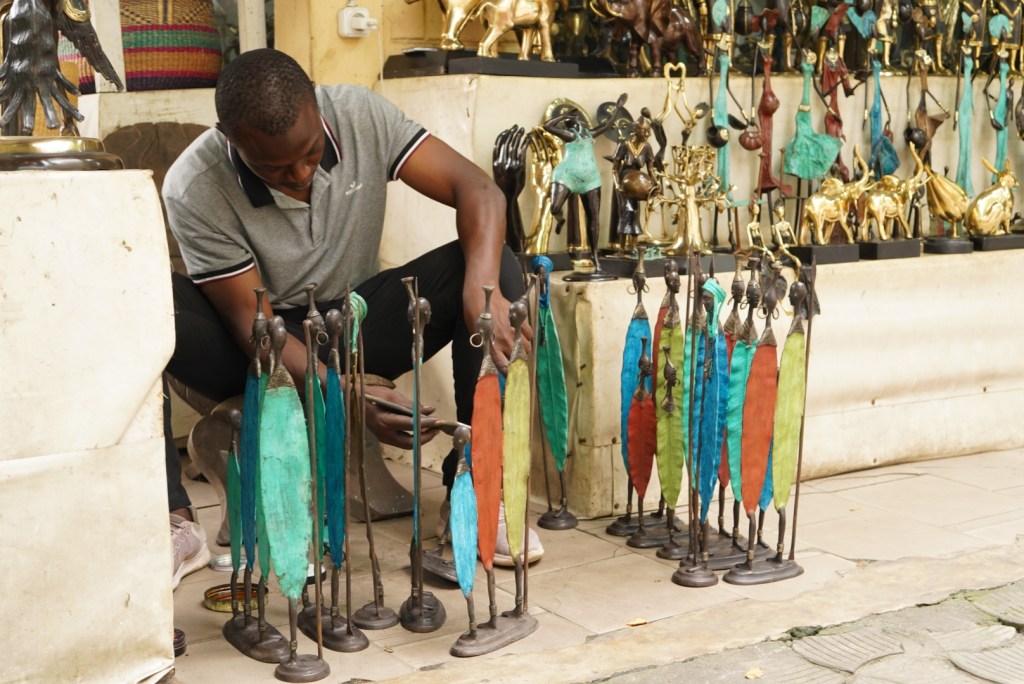
In December, I walked into the Artisanal Centre of Abidjan with a clear intention: to speak with artisans about art, memory, and their possible connections to reconciliation. What I encountered instead was the first quiet contradiction of the place, there were more sellers than artisans. The consequence was immediate: fewer creators to engage with, fewer stories anchored in lived practice. Still, three encounters stood out, each revealing a different layer of what art has become, and what it risks losing.
My first conversation was with Sir Touré, a traditional mask seller. We spoke directly about the meaning of masks and their relationship to social cohesion. Given that Côte d’Ivoire has endured a civil war, I was particularly interested in understanding the role art plays in preserving the social fabric.
Sir Touré explained that his contribution lies in representation. In his shop, all the major ethnic groups are present (from Baoulé to Yakouba). Each mask corresponds to a community, a people, a lineage. Yet when I asked about the symbolism of the masks (their social functions, their rituals, their stories) his answers remained limited. Beyond identifying the ethnic group, he could not go much further.
That limitation revealed a gap. A gap between the artifact and its meaning. A gap that transforms an object carrying centuries of identity into a decorative item stripped of context. For the buyer, this absence devalues the artifact. For the seller, it weakens credibility. And for the community, it quietly erodes cultural transmission.
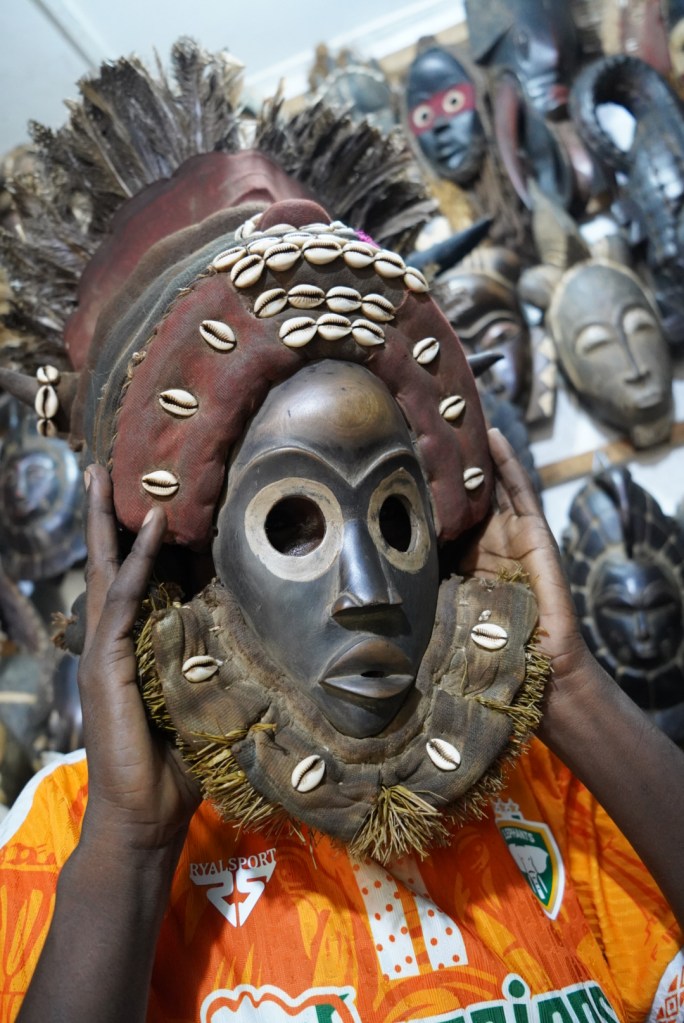
As we concluded our discussion, a simple but unsettling question emerged: why has art not yet been meaningfully connected to the digital world? A QR code attached to each mask could tell its story (its origin, symbolism, and social role) without placing the burden of encyclopedic memory on the seller. Technology, in this sense, could serve preservation.
My second stop was Alpha’s shop, a brass jewelry outlet. The craftsmanship was undeniable. Each piece was polished to near perfection. Our interaction, however, was brief. When I asked about the link between his work and social cohesion, he did not see one. His objective was straightforward: to sell as many pieces as possible. When I inquired about production time, his answers were vague. His role, he clarified, was primarily finishing and polishing. Creation, it seemed, had already been outsourced elsewhere.
It was only later that I met what felt like the first full artisan of the day.
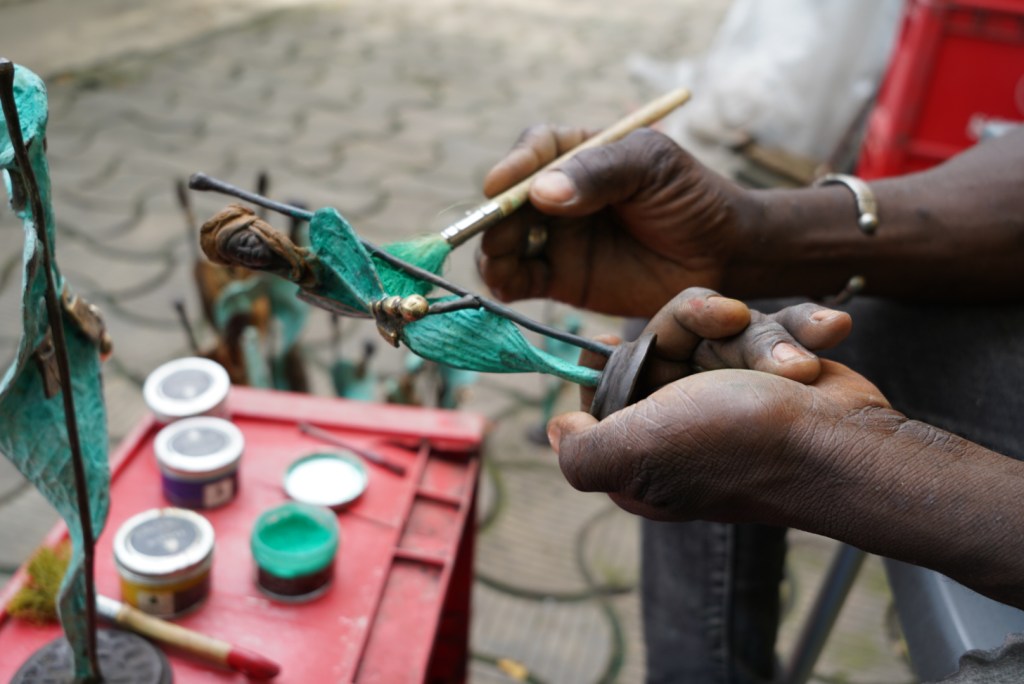
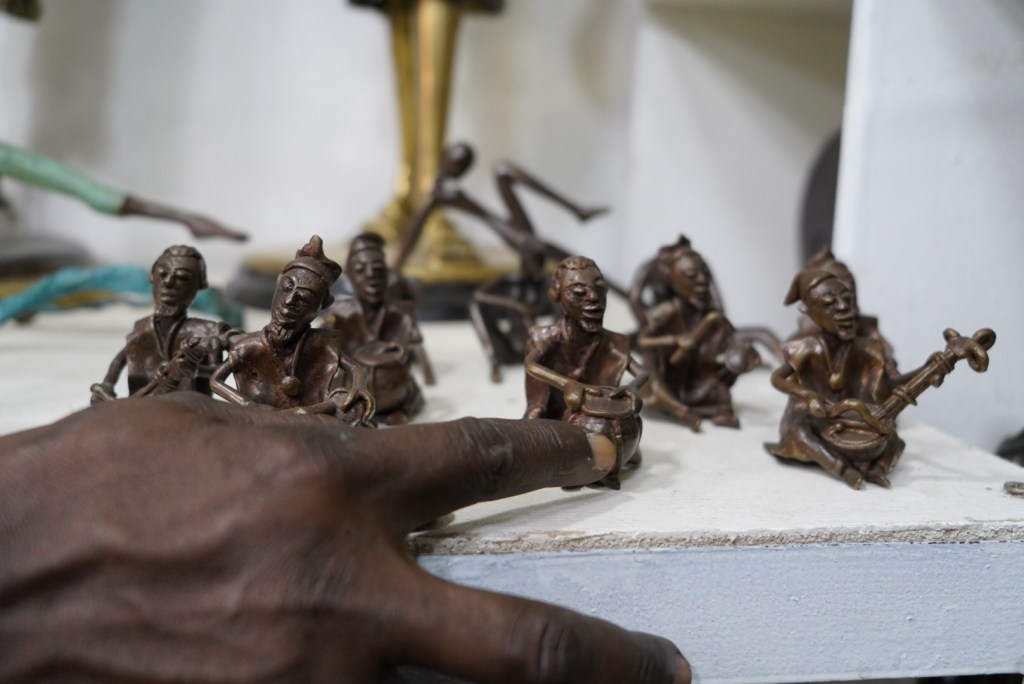
Zakaria welcomed me into his workspace, and our conversation lasted more than two hours. He works with bronze and brass, moving between Abidjan and Ouagadougou, where he owns several shops. His artifacts emerge from personal creativity, cultural memory, and experimentation. What began as a discussion about technique gradually unfolded into a deeper reflection on art as a value chain, with its vulnerabilities, contradictions, and structural neglect.
Intrigued by the high prices of certain pieces, and aware of the broader social context, I asked whether he differentiated prices between locals and foreigners. In the art world, I suspected this was unlikely, and he confirmed it. Art, he explained, does not accommodate such distinctions. I pushed further, pointing out that this reality effectively excludes residents as a target audience, depriving them of access to their own cultural production.
This is where the conversation shifted. Zakaria introduced the role of government, not merely as a cultural patron, but as a structural guarantor. For him, public institutions must ensure that artisans can live from their work. Without that protection, art loses its soul and drifts into mass commercialization. He explained that each piece he creates is registered with the ministry as intellectual property. The state assigns a value, compensates him for new works, and protects them against counterfeiting. Unauthorized reproduction becomes a legal offense.
I was genuinely surprised. I had long assumed that artistic protection in many of our countries was weak or symbolic. Here was evidence of a framework, imperfect, perhaps, but present.
Zakaria then spoke about finance. Accessing bank loans, he said, is nearly impossible without guarantees such as land titles—assets most artisans do not possess. Even when loans are granted, they are capped at very low amounts, around 3,000 USD, far below what is available to traders or actors in other sectors. Sensing my disbelief, he added calmly: “In my opinion, an artisan should not take loans.”
When I asked why, his answer was simple and compelling. Art is not trade. It depends on imagination, time, energy, materials, and emotional investment. It is handmade, unpredictable, and exposed to volatility. Loans, with their rigid repayment schedules, impose constraints incompatible with creative processes. The risk of default is high. Better, he argued, to grow slowly than to be trapped by financial obligations that suffocate creativity.
I found myself agreeing, perhaps influenced by my own skepticism toward banking systems.
We then turned to raw materials. Zakaria explained that much of what he uses comes from household waste: plastic containers, old saucepans, broken utensils. What families discard is collected, sometimes purchased for small sums, and then sold in bulk to enterprises that melt and resell the material. To make it concrete, he offered an example: a mosquito net filled with plastic bottles sells for 15,000 XOF (about 27 USD).
I paused. In a city like Abidjan, the scale of this activity is immense. Half-jokingly, I suggested organizing a youth cooperative around waste collection. We laughed, but we both knew it was no joke. This informal chain generates steady cash flow and feeds the art sector from the ground up.
From melted material purchased by weight, Zakaria creates artifacts that eventually re-enter the market as cultural objects. Art, once again, reveals itself not only as expression, but as an economy.
We ended our conversation acknowledging the same concern: without individual passion and stronger institutional support, this sector remains fragile. The risk is real, to lose centuries of savoir-faire and replace them with art that is commercial, standardized, and empty of identity.
And perhaps that is the deepest loss of all.
Nevertheless, the Artisanal Centre of Abidjan remains a place worth visiting. A space where dialogue with artisans is still possible, and where meaningful conversations can open pathways to understanding art, identity, and their future.

 Cameroon Passport Diaries