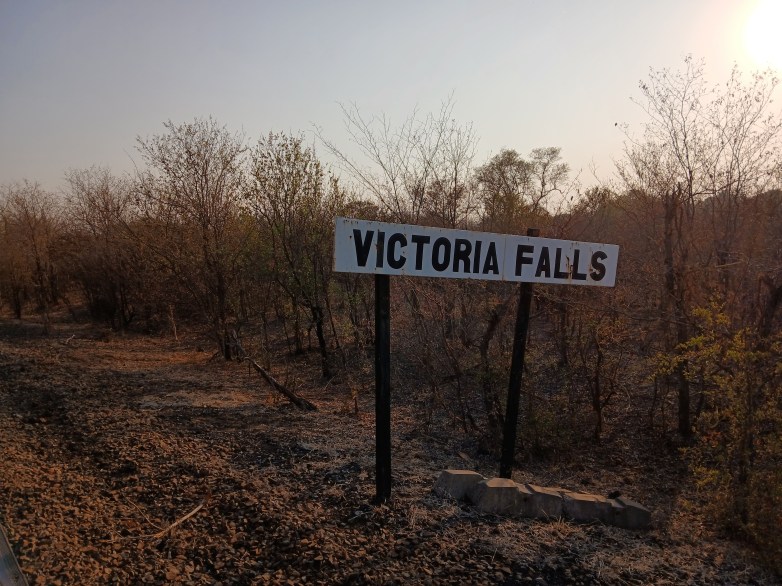
Finally, here we are in Victoria Falls town. The morning after our arrival, we explored the town for a time to rest and figure out what we wanted to do. Being an early bird, I took a walk while waiting for my friend to wake up.
My fifth observation (yes, it’s the 5th one, remember, this is Part 2): Victoria Falls town is gorgeous. The town forces you to activate holiday mode, if it hadn’t already been switched on. My first stop was at the tourism office, a place I highly recommend to fellow tourists who would like to better understand the tourism landscape in the town and in the country more broadly. I met a welcoming staff member there who gave me valuable information and suggested some activities for my friend and me to enjoy.
Art Galleries and the Question of Identity
Continuing my solo patrol, I stopped at two art galleries. The first was run by a Zimbabwean lady, with whom I felt comfortable enough to ask about the dynamics between Black and white communities in Zimbabwe, mostly from an economic angle. Straightforwardly, she said: “In this market landscape, we may run, but we do not own.” I could not grasp the full depth of that statement until I had spent more days in the country and returned to the city more than once. Victoria Falls town’s tourism market is still economically dominated, in large part, by one section of the community. During that stay, I visited three businesses owned by Zimbabweans: the Mbano Hotel, Simba’s Artisan Bakery, and the GOAT restaurant. There are surely more, beyond the main tourist hub.
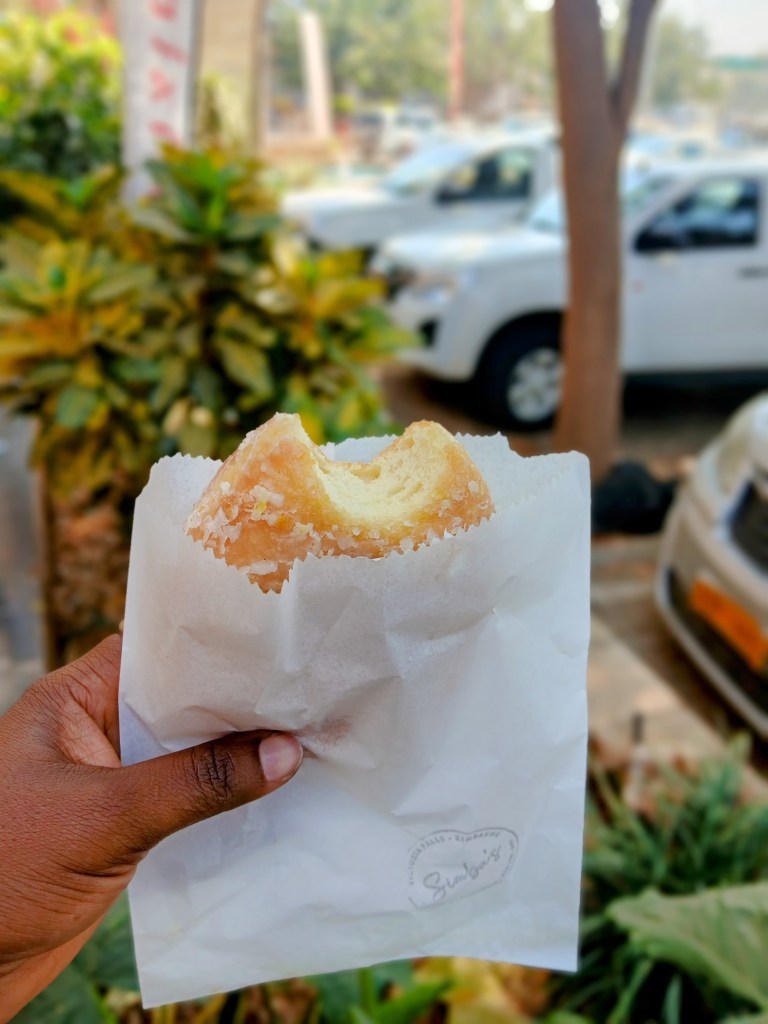
After my exchange with the lady running the gallery ( from whom I bought a beautifully designed bowl as a souvenir) I moved on to the second art gallery, where I had the chance to meet the owner herself, not just the seller. She was primarily a photographer. She asked where I was from, and was delighted to show me some masks she had acquired from Cameroon. I returned the curiosity and asked about her own origins; she answered: “I am the 3rd generation of white Zimbabweans. […] I belong to the Tonga ethnic group.”
For those who know me (and know my facial expressions) I gave her the look that said: “Sorry, but what on earth are you talking about?” Do not get me wrong; I respect the way she presented her identity. My shock came from the fact that she was the first person through whom I had ever heard the expression “white Zimbabwean.” I did not ask further about her background, because my biases were beginning to take over, and I was drawing the conclusion that her great-grandparents had been settlers. Had they benefited from colonial rule? People, you had better book your flights, come here, and ask that question yourselves; I am not in the business of stirring things up on holiday.
As I stepped out of her gallery ( having bought some lovely pieces of her work ) my mind fell into a spiral of thoughts about Zimbabweans and their white compatriots, or, as she put it, “the white Zimbabweans.” Identity is complex, and defining one’s own identity in a context such as Zimbabwe is even more challenging. Because no matter how you present your origins, more questions will follow, or sidelong glances will be directed your way.
As it was already lunchtime, I headed to the Lookout Café for my meal. The place was packed. It is a very lovely, well-established restaurant, so you would do well to call ahead and book a seat with a view of the falls. Fortunately, the staff found me a spot. I ordered and waited for my friend to arrive, but my mind was still unsettled, still wrestling with that question of identity, and drawn back to thoughts of the colonial era in Zimbabwe.
The Falls: Zimbabwe Wins, No Contest
The next day, we went to Mosi-oa-Tunya (Victoria Falls). As we arrived early, we had breakfast at the Rainforest Café, and my palate has been forever grateful to me for that decision. I ordered the mushroom poached eggs, and I cannot recall ever having tasted an omelette as good as that one. It was perfect.
Belly satisfied, our legs and eyes were ready for their own reward. We set off on the trail to witness one of the most majestic natural wonders on earth. The falls did not disappoint us. They were magnificent and magical.
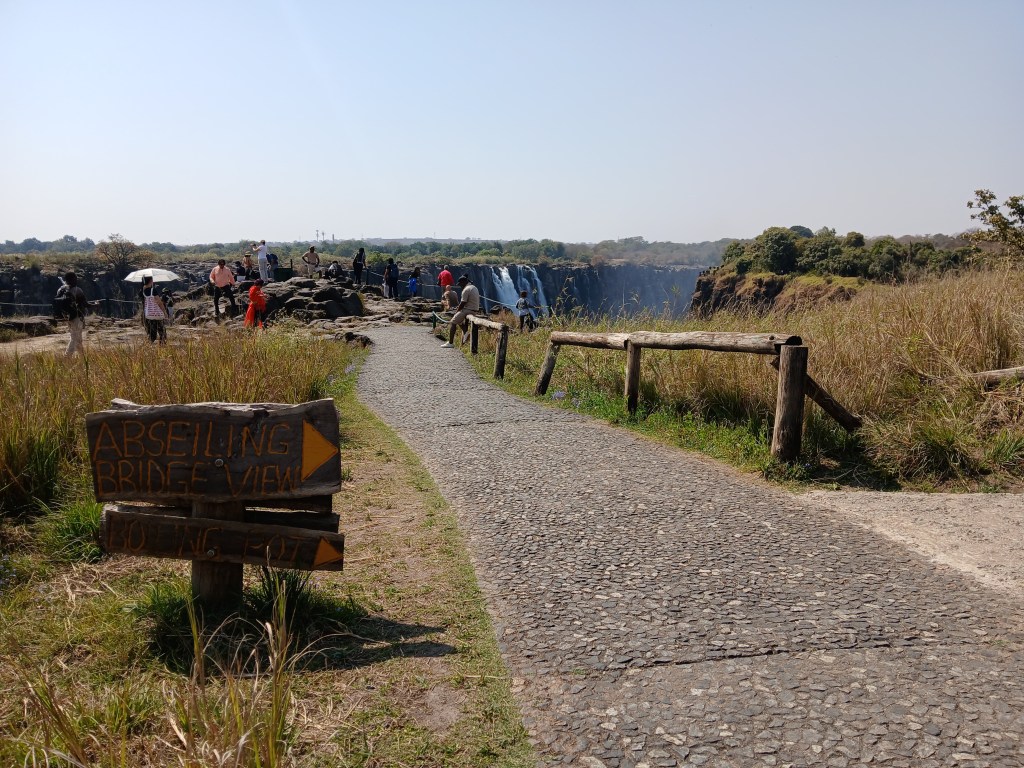
I had already seen the falls from the Zambian side, but without doubt, Zimbabwe has the better view. No further discussion on the subject.
Luaka, the Cab Driver, and a Chance Encounter
Moving on in our journey, we met a young man, Luaka, who drove a cab in the town. We decided to use his services during our remaining days to better get to know the area. On our first ride, while driving through the upscale part of Victoria Falls town, the car broke down and we were forced to stop for repairs.
I could already sense that Luaka was growing tense, though I did not yet understand why a feeling of unease seemed to be taking hold of him.
A gentleman in his early thirties stopped and asked if we needed help. Luaka explained what he needed, and the man asked us to wait while he went home to collect the necessary tools. It was a kind gesture, the sort our world needs more of. When he returned and handed the tools to Luaka, I thought for a moment that Luaka was going to faint. He could barely hold eye contact with the gentleman and used both hands to receive the items. He was visibly uncomfortable, the kind of discomfort that exists only between communities long kept apart. Yes, you guessed it: the gentleman was a white Zimbabwean.
While Luaka was fixing the car, I struck up a conversation with the gentleman. He told us he lives in Bulawayo ( the country’s second-largest city) where his family owns a farm. He took the opportunity to share that Zimbabwe produces some of the best beef in the world and exports to countries including New Zealand. I am not a big fan of beef, but it was genuinely lovely to see how proud he was of his work as a farmer. By the time we finished talking, Luaka had also finished the repairs. We thanked the gentleman warmly and continued our tour.
Later, we stopped at Baines Restaurant for lunch. In honour of the gentleman, I ordered a steak. After eating a good portion of it, I called the waiter over and asked whether my meat was really beef, it was so exceptionally good that I simply could not believe it. The gentleman had been right. The beef in Zimbabwe is absolutely succulent.
Walking with Lions (and Other Wild Decisions)
We woke up with excitement every day, knowing that new experiences awaited us. And one day, we decided to go for an extreme one: walking with lions.
Trust me, on my own, I would never have chosen such an activity. Thank you to my friend, who was not willing to face near-death alone and so brought me along for the ride. We went to a reserve to walk side by side with white lions. It was a wild experience.
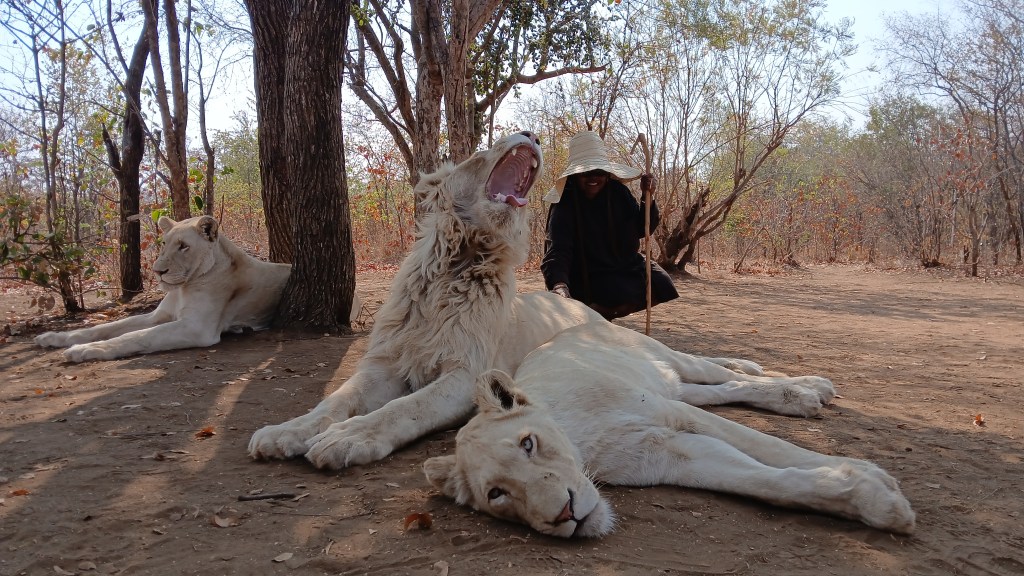
To my fellow Africans who have unresolved matters with their ancestors or their elders back home: I do not recommend this activity. And for what it is worth, I will never do such a thing again.
As if that were not enough, afterwards we went to MaKuwa-Kuma Restaurant for lunch, and someone came over to offer us another activity: feeding the vultures. I simply said “absolutely not”, I will not tempt fate twice in the same day. And beyond that, vultures are peculiar creatures — you know what I mean. I do not trust their energy. From where we were seated, we could see hundreds of vultures arriving to be fed. Nothing to write home about, trust me.
The Cultural Show That Wasn’t
For days, we had been trying to get a reservation for the Boma Dinner, the well-known cultural show featuring a buffet, drumming, and dance, which is something of an institution in Victoria Falls town. We never managed to secure a spot. To compensate, a staff member at our hotel suggested we try a similar event taking place at one of the other hotels in town. We eagerly said yes, little did we know it would be the most unsettling moment of our stay.
That evening, we arrived at the Victoria Falls Hotel, where the show was already underway. We paid around $30 each for the buffet and settled in to watch. Something felt off, energy-wise, and I was uncomfortable in that environment from the start.
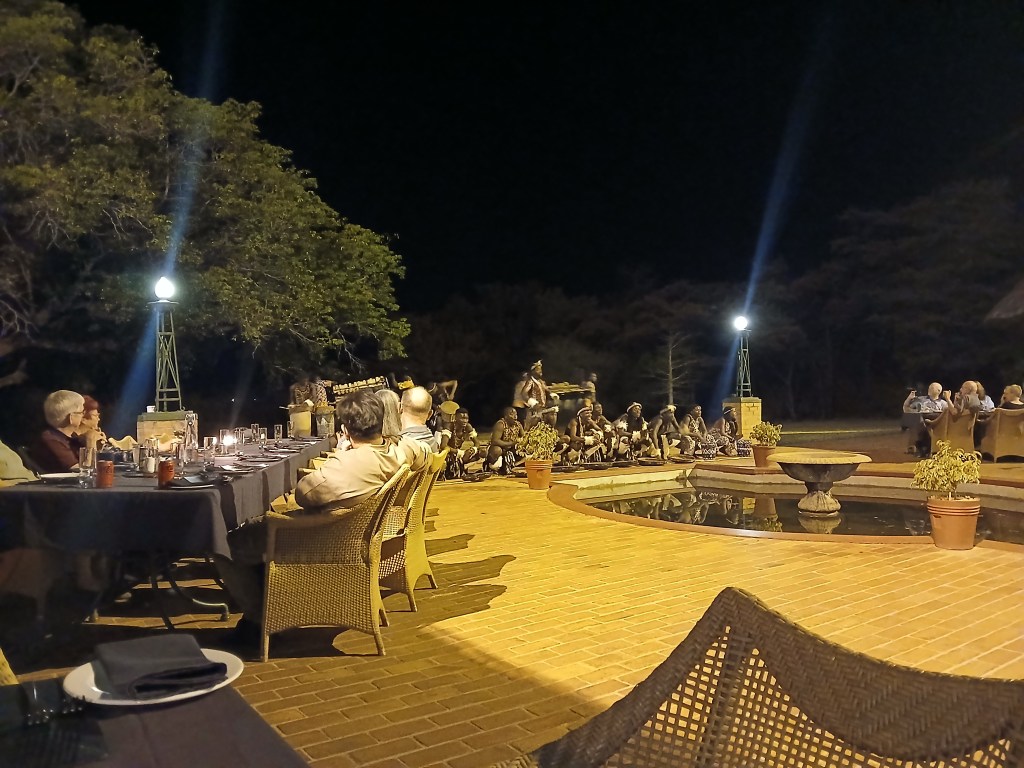
The show itself held less of my attention than the audience did. In a moment of quiet observation, I noticed that my friend and I were the only Black people sitting in the audience. The other Black people present were the dancers, the drummers, and the hotel staff. It was a scene straight out of the colonial era, blatant and unambiguous. My friend and I did not stay long; we left the hotel.
On the way out, I took the time to look at the building itself and its décor. This hotel is a relic of colonial times. Everything looks aged, and yet very much preserved in that history. In that moment, I was transported back to the feeling I had had in the guest house in Harare, which was equally steeped in colonial nostalgia. The architecture of that era is unmistakable: almost the same configuration every time — a large garden, a swimming pool, a fireplace, Black staff, old photographs, Victorian style… and so it goes.
The Train, the Bridge, and the Story Left Out
The more we were moving between various activities and settings, it became hard not to see what colonialism has left as a blueprint in the community.
One morning, we decided to take the Bamba train to view Victoria Falls from the bridge connecting Zimbabwe and Zambia. A young guide was responsible for the group and was called upon to speak about the construction of the bridge. His account praised British engineering but omitted the African labour used to set it up. Local men endured unimaginable hardship, pain, and loss to raise that structure, yet their story was erased from his retelling.
I was so troubled by his account that, at the end, I approached him and shared my feedback. He was receptive enough, but how much of it he will integrate into his future narratives, I cannot say.
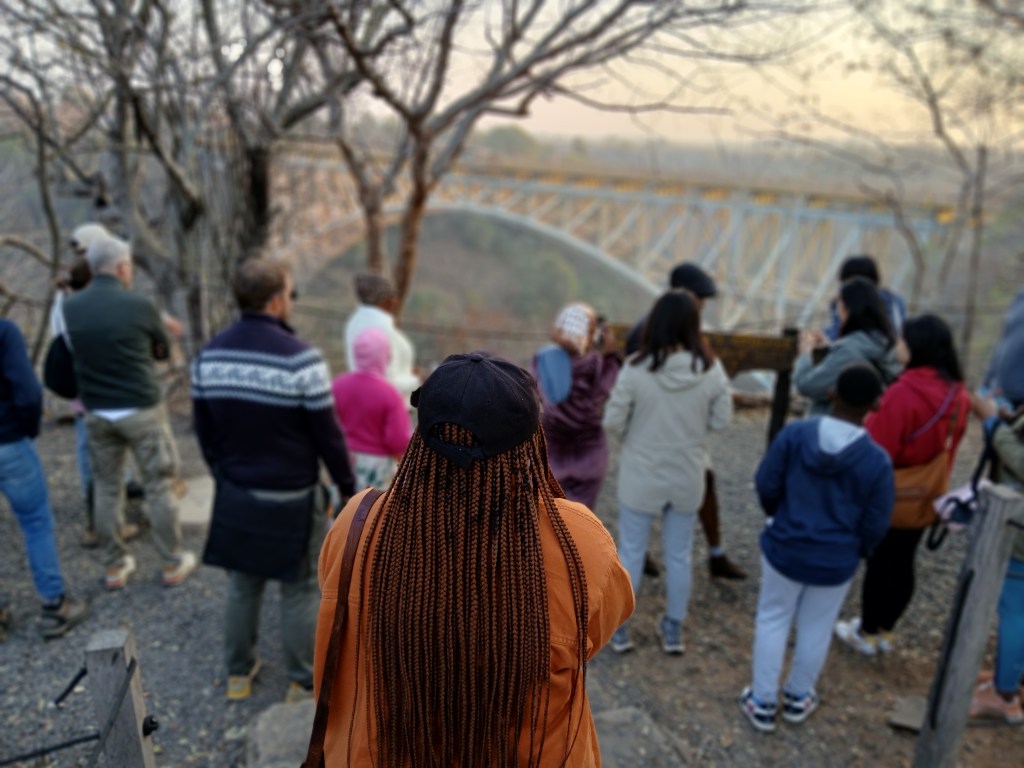
This kind of selective memory is not trivial. Tour guides, standing at such historically significant sites, have the power to tell critically balanced stories. But too often, their narratives echo colonial legacies rather than amplifying African perspectives.
Tourism, Colonialism, and the Need for Change
You may wonder: “Where are you going with this, Nana? Are you really bringing colonialism into a conversation about tourism?” I am afraid I must.
Zimbabwe is one of the few countries I have visited where I have witnessed such a stark disparity within the tourism sector. Ownership is not in the hands of the local community, and the community cannot afford to participate in the activities that tourism generates. Tourism is expensive, and I will explore that further in another article.
When we speak of just sustainable tourism, we are talking about building ecosystems driven not solely by economic profit, but by a broader awareness of ecological, political, and social realities; ecosystems that take responsibility for not reproducing systems of marginalisation and exploitation.
Tourism policymakers, authorities, and operators have a responsibility to create an environment in which the structures of colonialism are not replicated. How do we set activity prices so that national residents can discover their own country and benefit from it? How do we train tour guides to deliver balanced narratives and serve as bridges toward reconciliation? How do we ensure that the economic landscape is diverse enough to prevent monopolies that could make it fragile and risk reigniting old conflicts?
In a context like Zimbabwe’s, where the colonial past is very much still present, the tourism sector has a major role to play in bridging the divide between communities, not only economically but socially as well.
You may ask why I bring in the social dimension. Victoria Falls town has two faces: the glamorous one, where most activities take place and where most tourists stay; and the other — where national residents live, where hotel and tour company staff return at the end of the day, and where the infrastructure is far less appealing. Victoria Falls town still bears the scars of segregation between its Black and white communities. That will be the subject of the third instalment of my journey through Zimbabwe.
In the meantime, visit Zimbabwe, because it is the land of wonders.

 Cameroon Passport Diaries